

TRANSCRIPT:
(This transcript is derived from an automated process. The video recording is authoritative.)
Damian Coory:
So I went to university in the 1980s at Queensland University of Technology or QIT as it was known then. And I studied the Bachelor of Business communication with a major in journalism. And I went back there yesterday, sorry, on Sunday for the March for Australia at the Boten Gardens. And it was the first time I'd been back to B block where we used to have our lectures in quite a long time. And I looked around and hanging from every single pole at the university was the full rainbow flag. By full rainbow flag. I mean the full woke rainbow flag that's got the brown and black bars for the triangle thing to represent the ethnic minorities, racial minorities. And then it's got the circle, I dunno what on earth that means it's got the light pink and light baby blue for the trans people and others.
So I said to someone, are they just up there? Is it pride? I don't think it's pride week at the moment. Are they just up there for pride week or pride month? Oh no, they're permanent. And it wasn't just one of them. It was on every, it was like that pole, that pole, that pole, that pole, that pole for as far as the, I could see along the main walkway of QUT. So I find that quite fascinating and I think it's important that we protest. I mean, it'll probably fall on deaf ears, but if enough people do it, I'm intending to call the university and lodge a complaint that this is not, they do it in the interest and under the guise of kindness. And as Jewel just showed us why that is the case, that it sneaks in that way and then you look like the bad guy if you oppose it, of course.
And this tyranny has been going on for quite some time. The soft tyranny, obviously. Now, Queensland University is similar that if you look at their social science department, the heart of the left-wing thinking at the university, if you look in the foyer of that building, you'll see two giant murals on the wall. One of them is the Torres Strait Islander flag, the other one is the Aboriginal flag. You will not see the Australian flag anywhere. You don't see the Australian flag anywhere at QUT. This has got to be having an effect on kids. I was in Melbourne a few weeks ago, walked past RMIT, there was a staircase going up. That staircase was painted in the rainbow flag. So it's very subtle, but it's all pervasive and it's everywhere you turn and when you start to notice, it gets a bit creepy. So I want to just focus tonight on the media and how the media has been infiltrated.
I have spoken here before on some of that. I'm happy to take any questions about that. But I thought it might be interesting if we go into a case study tonight rather than me just talking theoretically. But we have a look at some very recent news coverage. So the protests on Sunday and the news coverage of those is what I want to focus on. The main issue, of course, affecting the protestors is the economic impact and the cultural impact and change driven by immigration that's happening at unsustainably high levels and at unprecedented speed in our country. Now, this is not an opinion, it's just a fact, okay? Obviously the narrative, and if you think in terms of narratives with media, it makes things a lot easier if you just look for the narrative. Who's the good guy? Who's the bad guy? In every story, stories are constructed by journalists. So the narrative here is that if you protest this, you are a racist. So you're a bad guy.
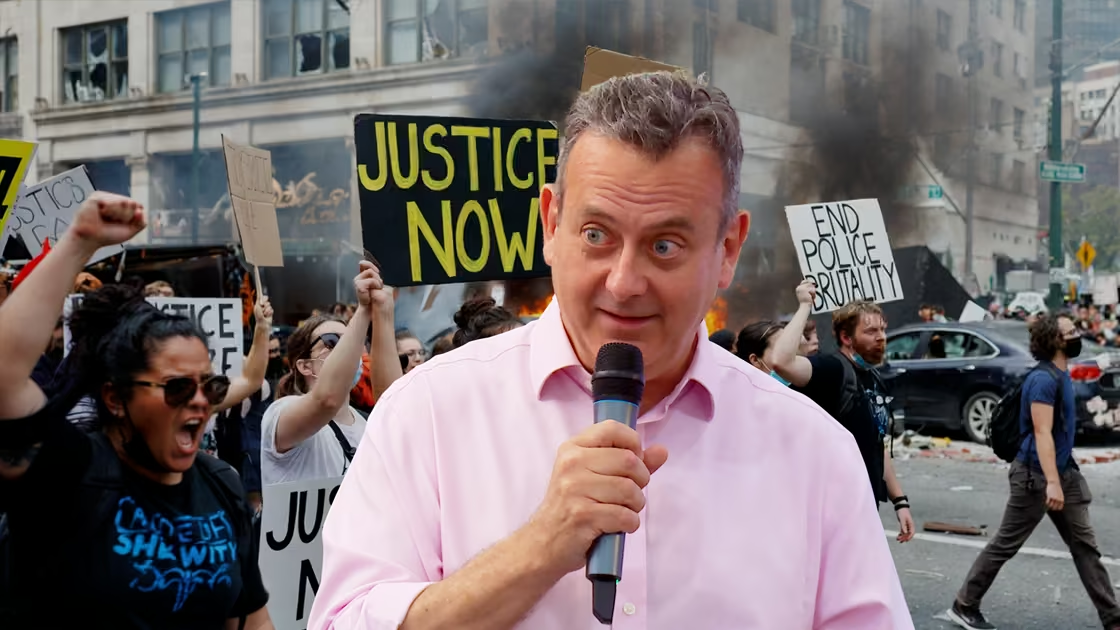
And what's interesting is what happened on the weekend was that we saw probably for the first time, I mean we saw it with the reaction to the murder of Charlie Kirk, and that started to wake a few people up. But we really saw it for the first time in Melbourne with the Antifa counter protest or the radical leftist counter protest to the March for Australia in Melbourne. And the police had to use some sort of tear gas and flash bombs and things to control the crowd. So let's get some data out there before the, OR data, depending on how you say it. Before the COVID debacle Australia had net overseas migration. That's the number that the government prefers that we use of just under a quarter of a million a year. Okay? Quarter of a million a year. Now, you could argue that that in itself is very high.
Not many countries take in just under 1% of their entire population every single year. In fact, only Uber woke Canada and Germany beat us in terms of percentage. In that regard. The UK and the US are way below that 1% level, but that's where we were at before C. Now in the COVID years, that dropped to about 93,000 average per year from 2020 to 2022. And in the three years since COVID, we've certainly more than made up for it. So a million in the first two years of the Albanese government and an estimated 260, which is a ridiculously low estimate that was in the federal budget this year, absolutely not going to happen to about 400,000 this year, depending on whose forecast you believe. Now, prior to 2007, when it hit that sort of nearly quarter of 1,000,200 30,000 roughly per year prior to 2007, that was Kevin oh seven, we took for decades of only a hundred thousand net overseas migration per year for decades.
No question never was raised, it was just stayed at that level. It went back to that during COVID and then after COVID. Here are the numbers, twenty twenty three, five hundred and thirty 6,000 all time high. These are financial year numbers. So it's July 22 to June, end of June, 2023, 536,000 2024 financial year, 446,000. So there's your million nearly. And then 2025, the forecast is two 60 to 400,000, and I would bet it's probably going to be around 400,000 Now. You'll hear people saying, this is the nom, and then you'll hear the NPLT. I'll sort of explain what the difference is there. But the thing is, do the numbers really matter? Are the numbers the only thing that matter? Because a lot of the impact of immigration is cultural and social. So it actually matters whether people are coming from like-minded cultures or is it racist to say that does a person's level of willingness to assimilate matter, a person's willingness to accept that the country they're coming to has a culture of its own that's been established for centuries, that they've got to try to adapt to that culture before they start shaping it.
I'm a descendant of immigrants. I've got Irish on one side, goes back three generations, and I've got Lebanese on the other. That goes back three generations. All of my grandparents were born in Australia. But both of those sides came very dominant ly, very strong cultures, and they brought their culture with them. They certainly had the richness I grew up with, even after three generations. It was still very Irish on the Irish side and very Lebanese things on the Lebanese side. But there was never an expectation that there was an immediate entitlement to start changing the environment that my great grandparents immigrated to. I'm pretty sure they came with an attitude of gratitude and an attitude of respect and a desire to assimilate and being grateful to be in a country that had a British rule of law and system of government, or Anglo Celtic, I should say so as to not offend my Irish ancestors.
But this is an important debate. It's an important debate. The people on the left have one view, we have another view, and the debate has to be had, but we can't have the debate if people keep saying it's racist to have it. But if we don't have it, guess what's going to happen? We're going to see more clashes and more violence and more racism, and we will see the emergence of problematic groups. Just take a look at what's happening in the UK and Europe. Alright? All right. Come back to those migration figures for a moment. What does that figure measure? It measures the people who haven't lived in Australia ever, and it measures the people who've been away for quite a while who are coming in and saying that they intend to live here again long term for at least a year. So it's those two groups.
So people who've never lived here at all and people who are coming home and saying, we're going to stay for at least a year. There's another number called the NPLT. Have you heard that? No. Alright, well this is the one that they were arguing was misleading. And the A BC was saying it's the wrong number to use because it's always higher than the nom. But the NPLT is the number of people coming in ticking the box saying, I'm going to stay for more than 12 months. And then 16 months later they issue the official norm, which is that number reduced by the number of those people who actually didn't stay and left. Okay? So to say that the NPLT is wrong, it's technically correct I guess, but it is a leading indicator and a very good one of what's happening. But recently, when the breakfast show host on two GB used the NPLT numbers to say there are five plane loads of five jumbo jets of people coming in every day, he got chastised by the ABC's Media Watch programme for using the wrong number.
But in actual fact, it was a perfectly fine number to use. It actually will probably round down to four plane loads. Wow, what a big difference. But they made a big thing out of the fact that he, and this is what they do, they shift the goalposts to argue about different things. Alright, so who are these people? What are the visas? Well, if we look at 2024, and we're working off the NPLT, but that's okay because we're just looking for the relationship. So 2024 international students were 207,000 out of, I think the NPLT was 460. So 207,000, almost half of them were students, but a lot of them will stay after they get their degree, right? They're using the degree as an entry point. 80,000 were working holiday. A lot of them stay, but many of them will go back. They're the commonwealth countries that we have these working holiday agreements with, which are great actually for young people.
We've got the temporary skilled visas, which they keep telling us is the main reason for these immigration numbers. Well, that was 49,000 out of the 400,000, 49,000 and long-term visitors. I don't know what they're defined as, but that was 90,000. And then we had, I think the others were Australian citizens and Kiwis. So returning Australian citizens and Kiwis in the broader mix. So not a lot of skilled migrants in that group. Alright, so excessively high immigration was the main issue at the marches for Australia. These concerned citizens are sick to death of being called racist just because they want to have a conversation about immigration. Many of them like me, are descendants of immigrants or immigrants themselves. Were there some racists in the crowd? Probably maybe even a real Nazi or two whoopty do, who cares? But they were absolutely dwarfed by other people. And it seems that even those who want Australia to remain predominantly European ethnically are open to sensible levels of immigration.
And people from different backgrounds settling here, provided they integrate, assimilate, and contribute as so many of our ancestors did. So this is an important issue. We've got to have a discussion about it, but unfortunately we can't because our media continues to run shallow garbage soundbite TV news where you get ten second soundbites, five second soundbites. You cannot express an idea or get into depth. Our current affairs shows are more like reality TV shows and magazine lifestyle shows than current affairs shows that the ones that I grew up with, where you'd actually get an interview, at least with a couple of politicians and they'd actually talk about an issue in some sort of depth.
Our political class, obviously we know are failing us and we expect the Labour Party to, but it's very concerning that not one liberal or national party politician had the guts to show up at any of the March for Australia rallies around Australia. Not one of them. At the Brisbane rally, Bob Katter, his state MP son, Robbie Katter, showed up to speak. Senator Malcolm Roberts spoke from one Nation, former l and p Senator the Jared, he's now the founder of the People first party. Every rally in the country was peaceful. There was a little bit of a scuffle in Sydney, a little bit of a scuffle in Brisbane with some of the, again, involving the left wing protesters. But Melbourne was the trouble zone. Now let's take a look at some of the media coverage. I just want to have a look. Firstly, I think we'll play Mark Burrows report from Channel nine. Mark Burrows has actually done a fairly balanced job compared to most of the mainstream media throughout this. It's not too bad.
Speaker 2:
Police officers have been injured pelted with rocks and bottles in Melbourne as they attempted to keep rival protesters from clashing officers kept the peace in Sydney as anti-immigration and anti-racism groups demonstrated across the country.
Speaker 3:
The city divided in one corner of Hyde Park, the anti-immigration march for Australia.
Speaker 4:
We don't have enough housing at the moment for the people we've got here and we are letting 'em in by the thousands
Speaker 3:
In the other corner. The rally against racism Australia for everyone we're built on the back of migrant, a different few down the road. You wonder why, why angry, so angry. She held up her own anti-immigration protest, several thousand rolled up united under the Southern cross, calling for immigration to be reigned in
Speaker 5:
Which that quality migration, not quantity migration.
Speaker 3:
At the last anti-immigration march, neo-Nazis gate crashed the front of the rally. This time no Nazis, ordinary Australians and young children are leading the front. She calls herself backed freedom, the national organiser for March for Australia.
Speaker 4:
In a crowd like this, you're going to have many different opinions. However, March for Australia's message is en mass immigration protect our heritage, our culture, and our way of life.
Speaker 3:
And imagine walking outside St. Mary's after morning mass to see a forest of flags and speakers calling for a halt to migration. Isn't that good? In Melbourne, the police had a tougher job using stun, grenades and pepper spray to keep the two groups apart.
Damian Coory:
Okay, so just notice what I want you to notice is the way that they frame this. So it's the, to keep the two groups apart, right? They used pepper spray to keep the two groups apart, not they used pepper spray to stop the left wing protestors attacking the right wing protestors who was peaceful. And this is after a press conference from the police being very clear about this
Speaker 3:
Democratic protest. Tactical police were pelted with rocks and glass bottles,
Speaker 5:
Not a small rock. We had our port members who come out with their right gear and their shields. These rocks were cracking some of those seals. Today
Speaker 3:
One officer suffered a broken hand, another cuts to their leg.
Speaker 5:
Today was a bad day for Victoria Police. I think it was a bad day for Melbourne
Speaker 3:
In the Brisbane march for Australia mp. Bob Catter vented his consumers. There's no jobs, all of the factories and production units.
Damian Coory:
Okay, I won't play that. The rest of that because I want to get to the point here, which is that the way that they selected those sound bites from the police press conference. So I just want to show you a little bit of what he actually said. I'll just get my time code here. 1 42. Yeah, he was terrific. So he started by throwing the rocks out of the box. I dunno if you saw that. So nice visual for the media, which is quite clever. I'll just play that.
Speaker 5:
Bins were put on fire flags, were on fire, and I think really enough's enough the disruption to Melbourne, to the general public.
Damian Coory:
Lemme just go to show you the rocks. So he started by tipping the entire box of rocks out onto the ground. And then
Speaker 5:
This is what was thrown at police today. And I think Melbourne has a gut full, I look on the social media streaming platforms of some of these issue motivated groups that the saying police used excessive force. The fact was these were being thrown to police bottles filled with shards of glass were being thrown at the police. Rotten fruit was being thrown at police. Now,
Damian Coory:
As a journalist selecting a 10 or five second soundbite, you would choose that, okay, you're going to use the dramatic throwing of the rocks. You're going to take the emotional part where it's talking about what's happening. But I would also have definitely used this part because have a listen to what he says around here
Speaker 5:
Today. People came to pick a fight with the police. The people that came to pick the fight were police, were the issue motivated groups on the left. I can tell you that the March for Australia group, they were peaceful. They were engaging. They listened to our instructions. They did what they were told, and they protested by example, the other group. And there were a number of issue motor groups known to us. We knew they were coming. We had to deploy hundreds of police, these hundreds of police, not only today, but the man hours and the weeks of planning, preparation, engagement with these people and the impact on Detroit police resources.
Damian Coory:
You can see the anger, right? So as a journalist, it's grossly irresponsible to ignore his very specific attack on the left here. Yet almost every network did. Right? So this is how news is crafted, constructed, edited, and manipulated in order to push a particular narrative. It happens every single day. It happens all the time. But the more ethical outlets don't do it, they let you see the important parts. And they're supposed to, journalists are not supposed to let their, so why do they? Well, they do this because what's happened is our Marxist friends that Jewel was talking about before have so infiltrated the university courses for journalists now that they're actually pushing and driving and teaching campaign journalism. So they're saying to kids, if you believe you are manipulating the narrative in the right direction, well, there you go. Well, they're at least not telling them not to do it in the way that probably some of my lecturers would've been telling us back in the day, or some of my actual bosses would've told us back in the day.
So a lot of this stuff happens by accident. Some of it happens deliberately. I think there's also another problem in which we've got a very, we've had a fragmentation of the media. There isn't a lot of money in the media business anymore. We've got a lot of young kids. They aren't very well paid as journalists. Most people my age are out of the business and trying to do something else and make some money because you can't have a career path in Australian journalism anymore, sadly, because of the fragmentation of the media and the fact that there's just not the revenue and that we don't have a very big population. America has a bigger population. So you can have different diversity of view. It's very hard in Australia with a small population to make a business. Even the podcast I do, it's not economic and it probably never will be without donations.
So it's kind of sad that that's the situation we're in. But we've got a lot of younging experienced kids. And on a Sunday in a newsroom, it wouldn't surprise me if it was an accident that half the time that they're saying the left-wing protesters and the one there was violence, and then they're showing pictures of the March for Australia people waving their flags. There was a lot of that on the weekend. A lot of the coverage was violence, violence, violence. And then pictures of people waving their flags from March for Australia, which leaves an impression in people's minds. If they're not paying attention to the story, as most people aren't, they're left with that impression. And unfortunately that's happening, not just deliberately as I believe it is in some cases, but also by accident and through lack of professionalism, lack of quality of journalism in our country today. There's no old blokes like me in the newsroom going, oh, don't do that sunny. Right. It just gets done nowadays. Alright, I'll leave it there. We're out of time, but thank you.


