
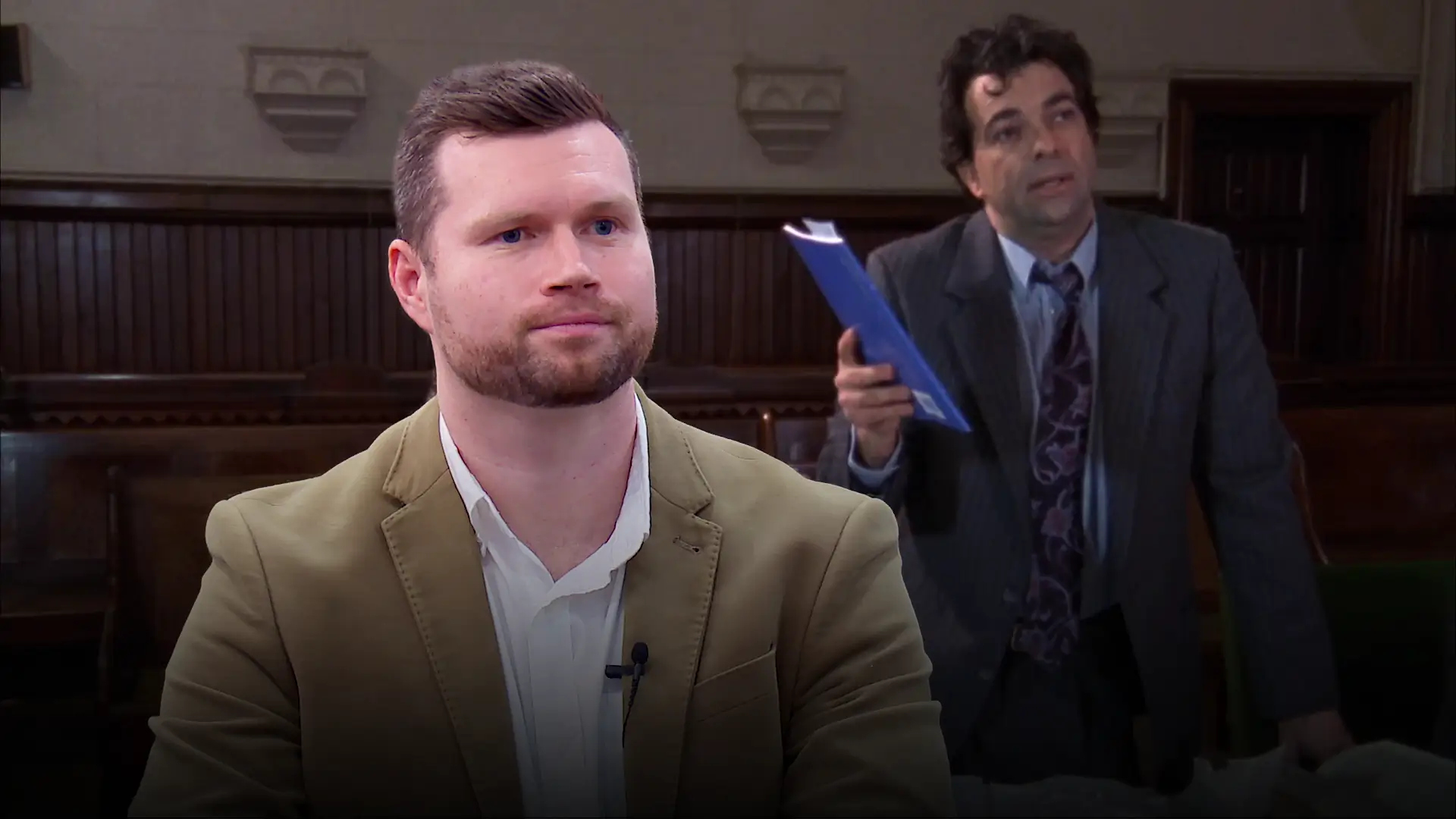

The Secret Case That Could End Vaccine Mandates Worldwide

A government lawyer by day.  Lead plaintiff suing the entire Queensland Government by night. He just built the biggest anti-mandate human rights case on Earth — and the state can’t kill it."  One man. Thirteen expert witnesses. Zero government experts. History in the making.

The Secret Case That Could End Vaccine Mandates Worldwide

A government lawyer by day.  Lead plaintiff suing the entire Queensland Government by night. He just built the biggest anti-mandate human rights case on Earth — and the state can’t kill it."  One man. Thirteen expert witnesses. Zero government experts. History in the making.

TRANSCRIPT: 

(This transcript is derived from an automated process.  The video recording is authoritative.) 

Jayden Beale:
Hi everyone. It's nice to talk to you all. This is really my first time ever speaking about this case. Yes. So I think I've spoken to a small church congregation once or twice, but I've had to keep it private for a particular reason, which I'll explain in a moment. If I'm too quiet too, just let me know, okay? I can speak a bit louder.

I was trying to figure out how to introduce myself. The best way to explain who I am is I'm a fairly junior legal professional who works in a legal office for the Queensland government, who simultaneously runs the largest human rights case against the Queensland government at the same time. So nine to five I represent the state and then after 50 PM I go against the state.

A quick backstory, I started this case, my first ever job out of law school was in the government's prosecution office as a law clerk. And then I went into private law in a personal injury firm and then I went back into government. And so all of this has coalesced and come about, I guess, coincidentally. And that arrangement is quite a strange arrangement and it's maintained itself and no one's figured out how to fire me yet. So that's probably quite an achievement. But other than that, I'll just quickly give you a quick bird's eye view of this case and why it's important.

So this is a human rights case. It's an anti-discrimination human rights case against the government's decision to mandate COVID-19 pharmaceutical products, they call vaccines, which were still being tested in clinical trials onto the entire state population down to kids as young as 16.

So all the other cases in the world, from my assessment and the assessment of other legal colleagues, all the other cases in the world have been employment cases. From my understanding, there's not a single case in the world. There might be one or two, which is maybe happening in such just extreme privacy, but we're not aware of any other case in the world that is proceeding to a trial on whether it was lawful to mandate drugs onto the entire general populace. And that's in any country. We're not aware of one in Queensland or any other jurisdiction in Australia.

So this is really a once in a lifetime, once in a century, if not more, opportunity to test whether that's lawful, which it obviously isn't. If this case does not proceed, if anyone knows anything about legal standing, you can't just go back in time and bring another case or you can't bring a case randomly 10 years later.

If this case does not proceed to trial, and it now is proceeding to trial after enormous effort, it is the only chance the public has on getting justice for that type of mandate on the general public. And it's probably the reason why I've maintained my conviction in the case is because, well, if I step away, there's nothing left.

There's been some employment cases. They've come and gone and some have won and some have lost, most have lost. But this case is really in particular because it affects everyone. And just to give you one last piece of context, the effect of the mandate was if a 16 year old kid needed to study for a high school exam at a public library unvaccinated, the consequence was that kid was liable to six month imprisonment if he was caught inside the library unvaccinated. So they were willing to put, I mean, they obviously would give the kid a small sentence if found guilty, but the possible sentence was a kid to be put in jail.

This is what the government had said as the rules of the mandates. A 16 year old unvaccinated kid could have been put in jail alongside hardened criminals for being unvaccinated. It's shame. It's an absolute shame.

Now, I run this case personally. I started this case as effectively a junior law clerk who had really no idea on these areas of law. I started this case in my high school legal colleague, friend's basement. We had to figure out how to do this. He was the only one who would talk to me. Once friends found out that I was going up against the government as an anti-vaxxer, I basically lost about 70% of my friends. And to be honest, I don't necessarily regret it. I'd rather have people who support me than people who pretend to support me in my life.

And just finishing off that bird's eye view, I've gone on to over four years with the help of some very supportive people who have been assisting me with no money, who've found out about my cause, people like Jerry Brady. Some people have come together to aid me. And I've built a human rights case where we've filed 13 expert reports from some of the most senior, experienced, renowned experts in the country, including in the world.

I've started on my own with no support, no money, no understanding of the area of law to have filed the largest human rights case in the world where we filed 13 reports from people such as Professor of Medicine, Wendy Hoyt. She's an officer of the Order of Australia. Professor of Immunology, Robert Clancy. He's a member of the Order of Australia. Professor Angus Del Gleich, one of the top professors of oncology and virology in the world, or immunology rather.

Professor Ian Brighthope, one of the most experienced nutritional medicine experts in Australia and in the world really. Dr. Philip Altman, one of the most experienced TGA drug regulatory affairs consultants. Two scientists from the Institute for Molecular Bioscience at the University of Queensland. It's a exotic research institute. How we've got in touch with these people.

As I said, people like Jerry Brady has helped put me in touch with these people. But how we've gathered these people from mainstream institutions is quite bizarre. It's remarkable and it's going to go a long way.

We've got an associate professor in psychiatry, a senior lecturer in immunology in Curtin Medical School at the Western Australia University there. We've got a general practitioner, Mel McCann, Dr. Mel McCann, as you're all aware of probably. Dr. Luke McLinden, specialised gynaecologist. We've got another super pharmacology expert as well. We filed 13 reports, whereas almost every case in the world would only file one or two reports. We filed 13.

 this case will be historic. We've built it. Well, I've built it for the purpose of the court will need to go against the scientific community to rule against us in this case. And I think that is the best way to do this. But that's the bird's eye view picture of it.

I just wanted to do a quick chat about how I started this case and how it's gone because the story of that should give everyone an indication of how it's so hard to go against the system, but you can succeed and we are succeeding. It just takes a lot of work and assistance, perhaps not just from people, but also from above.

So I will say this. So I was born in 1990. I was born in Melbourne. My parents moved to Brisbane, Ipswich soon after my birth. I finished high school. I was fairly good in high school. My interests were really just soccer and music really. My dad was an engineer. He enrolled me into engineering. I did two years of engineering at University of Queensland. And I stopped because I said to a friend, I said, at the end of an exam, I said, "I feel like the society is going to fall apart before I have the chance to build anything interesting." And wasn't that a prediction?

I didn't know the whole COVID madness and tyranny was going to ultimately come, but I think I made the right decision. So to defend against the, to act pursuant to that belief, I then became a punk rocker. I joined a punk rock band and played punk rock music for a year. And then I said, "You know what? I better get my life together."

And I started a law and criminology degree. And so I completed that and did all my training. And my first job out of university was my last year of university. I got a job, probably the best job you can get as a law student, which is at the office for the director of public prosecution. So I got a first job there as a law clerk and the law clerks would go into the court with the prosecutors and do all the big trials, rape trials, murders.

I didn't do any murders. There's some manslaughters, but burglaries, all the big cases. So I was thrust right into the legal system really. And it was a great job for experience. And then also that was the same year that the Queensland government implemented the Human Rights Act. They passed the first ever Human Rights Act in the state.

There's not much human rights legislation in Australia at all. So I, strangely in 2019, had one of the first ever briefings on our Human Rights Act. And I was there in the courts in the first ever real world examples, real world applications of the Human Rights Act. Queensland passed a Human Rights Act the same year that COVID-19 was controversially released into the world. And it's that same Human Rights Act that has allowed this case to proceed and has allowed me to build the biggest legal case in my opinion in modern decades, in recent decades against the government.

So it's a strange coincidence there. And I also had real world knowledge of it as well.

And so when COVID-19 came about and they started to do all these mandates, I had a really close knowledge of the act and I knew this was never going to hold up. And I'll get to this, but the government has refused to disclose any evidence justifying the mandates for four years. And so I think they know that this was never going to hold up as well. But with that background, I then moved into a personal injury firm to get some better experience.

And that's when the COVID-19 vaccine mandates hit in December 2021. Prior to that, I had no real interest in COVID-19. I had no real interest in COVID-19 vaccines. I'm a Christian. I don't get vaccines and I don't really take much pharmaceutical products at all really because I believe I've got a duty to glorify God with my body and not the government or others.

And so I believe God's given me a pretty good body. So I'm happy to keep it as is for the most part. But the other part of this case is also all the other human rights which were important to us. The right to life, the right to not be subject to medical experimentation, the right to not be subject to medical treatment without our consent.

And I'll get to the medical experimentation shortly, which is going to be a big part of this case. But I didn't really have these fanatical views about COVID-19.

What happened is that a high school friend and a legal colleague called me and said, "Jayden, are you getting vaccinated?" And I said, "No." And he said, "Well, you're about to be banned from almost every building and venue and business in the state." And I said, "You're joking." And he goes, "What are you going to do?" And I said, "Well, I'm not going to get vaccinated." And he said, "Well, then are you just going to what, live as a hermit?" And I said, "No. I'm going to walk into the court next week and I'm going to take on the government." And he said, "How are you going to do that?" And I said, "I don't know."

So I had worked in criminal law at that point, and I just started working in personal injury law, which was institutional. This is a little bit of background too. I was specialising in institutional abuse law as a senior paralegal and law clerk moving into a lawyer position. I was still quite junior. And so a lot of our cases were against the government.

So I'd had a taste for going against the government at that point. But to get this case into court, I had to know everything about administrative law and the Judicial Review Act. I'd never even touched it or barely studied it in uni. I had one week to prepare my knowledge on that whole area of law and that whole act.

And it was up until 45 minutes prior to the hearing that me and my mate, my friend was still texting me and we're still figuring out what the law was. And the government, I was about to walk in. It was on the day the mandate started, 17th of December 2021. I had to walk in with just satisfying myself on the law 45 minutes prior to the hearing.

I had to walk in to one of the most senior judges on the Supreme Court who started off by saying, "Mr. Beal, you don't understand this area of law. The decision was to reject my exemption application from the mandates on religious grounds." And then I expanded the case to make a massive human rights case against the whole mandates in full. But that's a little bit of technicality. I'll get to that. But he said, "Mr. Beal, this is not a revealable decision."

The government barrister said, "Mr. Beale, he's just a law clerk. He's self-represented. He doesn't know what he's doing." They both teamed up against me. I then was giving 10 minutes to talk. And when I finished, the whole room was silent.

The judge's associate in front of me had a jaw down to the ground. And the judge just looked at me, perplexed, turned to the government barrister and said, I think it was Mr. McMillan at that point, he goes, "Mr. McMillan, any counter argument?" And Mr. McMillan goes, "No." And then the judge said, "I think Mr. Beal's correct and I'll list the matter for trial." And if I didn't win that hearing, that was called an applications hearing, this case would never have proceeded.

So I guess the point of that is not to brag. The point of that is to say this case began not through big law firms and the top councils, the top barristers in the world or the country coming in with all their money and their nice suits.

This was just a law clerk, self-represented who had a few days to research the law. And he was able to convince one of the most experienced Supreme Court judges that the case had merit to proceed pursuant to law. And so I won that hearing.

So that was quite an extraordinary moment. And that's when I realised, okay, we're in the money here. Leading up to that, I was with a partner at the time who's gone on to give a statement in this case. I just newly met her and we'd been dating for about a month.

And so I had to disclose to her that, I said, "Hey, I'm going to do something remarkable here. I'm going to self-represent myself against the government, against the COVID-19 vaccine mandates." And she goes, "It's interesting you say that because I've been having severe chest pains ever since my COVID vaccine, so three days after a vaccine." And I said, "You're joking. Why didn't tell me?" And she said, "I didn't want to bother you." And I said, "Okay, well." And I said, "That's interesting. I've already decided to run the case at that point." And we chatted about it. We talked about medical treatment and stuff.

I then called my friend at my previous office at the director of public prosecutions. And I said, "Jake, I'm going against the government for the vaccine mandates. Should I be doing this?" And he goes, "Well, it's interesting you say that. I've been on a heart monitor ever since my vaccine." And I said, "You're joking." He goes, "Yeah, they call it a regular heartbeat," something like that.

Anyway, I then called my other good mate from high school and I said, "I'm going to the Supreme Court next week against these COVID vaccine mandates." And he goes, "Oh, that's interesting. I now have extremely high blood pressure right after my COVID vaccine." I said, "You're joking.

This was a string of three individuals, my partner and my two friends. I hadn't spoken to anyone in between that. It was conversation, conversation, conversation, three vaccine injuries."

I said, "This was so bizarre. I'm going to go talk to a doctor." And I said, "So this is rewinding a bit before that applications hearing." I said, "Before I go to that hearing, I'm going to talk to my doctor." So I called a local GP at Oxley Medical Centre. His name was Dr. Dixon. I called him up and I said, "Dr. Dixon, I'm thinking about getting a COVID vaccine." I wasn't. I just wanted to hear his views. I said, "I'm thinking about getting a COVID vaccine. Can you tell me something? Interrupt."

He then starts yelling at me over the phone. And I'm like, "Whoa." Teleconference. And I go, "Whoa, whoa, whoa. Why are you yelling at me?" This is a real conversation, by the way. I go, "Dr. Dixon, why are you yelling at me?" He goes, "Stop, stop, stop, stop. I am not talking about the COVID vaccines." And I said, "Okay, well, that's the purpose of my call." He goes, "If you want to talk to someone about the COVID vaccines, you need to go elsewhere."

And I said to him, I said, "Listen, Dr. Dixon, this might sound a bit weird. I work in the legal profession. I understand doctor-patient privilege." I said, "Knowing that this is private, can you tell me why you're talking like this to me?"

And he goes, "I shouldn't be telling you this, but I'm being dragged before a magistrate next week. The government's trying to take my medical licence because I recommended that a 50-year-old woman not get a COVID vaccine because she had some comorbidities." And he had no idea what the COVID vaccine would do to those comorbidities. And I said, "Well, that's ridiculous."

And I hung up the phone and I took a deep breath and I said, "This is a string of four conversations in a row."

And then the last thing that happened is I drove to the Gold Coast with my partner to have a nice day at the beach and I got caught up in a three hour march at Tweeds Heads against vaccine mandates. And I said.

[applause interrupton[

You know what it's funny? What is it? Rainbow Bay duck? Does anyone know that duck? They have a duck down there that surfs on the waves. The lady came over and put the duck on my bonnet. It was a funny time actually while we were moving through the.

But what I realised from that march is I wound down my window. And up till that point, the media had painted all these people who are against vaccine mandates as nut jobs, anti-vaxxers, wackos. You'll actually know this. You were the most rational and science consistent with science-minded people that could possibly exist.

You've got 13 experts from leading institutions and fields and medical and scientific fields who completely agree with you. So that's the irony there. But I wound down my window and I said to this lovely couple, "What are you marching for?" And they said, "Against COVID vaccine mandates."

And I just remember looking at these people and just going, "These are the most normal looking, sounding people I've ever met." And I said to myself, "Everything is wrong here. My partner's injured. My two best friends are injured. My local GP is being dragged for a magistrate. Normal regular people are marching through the streets." And I said, "Something is definitely big here."

And I say that because at that point, I didn't really have this intimate knowledge of COVID-19 and the problems with the vaccines and how COVID-19 came about. I went on to find out. So yeah, I started in the Supreme Court. I ended up fighting the government over some disclosure. The government refused to disclose to me all the material, any material that the government relied upon to give their mandates. We went on this big fight of disclosure. They asked me if I wanted to go to trial. I said, "I'm not going to trial without disclosure." Well, they said, "Well, okay. Well, you've missed your chance to have a trial. You're going to have to change jurisdictions." At that point, I had one expert, just a sociologist.

And if I had gone to trial, I probably would have lost the case. And so the government said, "Well, we finished the mandates now. You arguably shouldn't be here." And I said, "Okay, well, I'll go down to the anti-discrimination tribunal called QCAT." And they said, "Okay, well, off you go." And I went down there and instead of the sociologist, I said, "Don't need you anymore." And I ended up filing 13 expert reports from the top medical doctors and scientists in the country. And so the government thought I was going to go away, but I ended up just filing the biggest case in history against the government. And ever since then, the government has been flailing, wailing, and desperately doing everything they can to get this case out of court. The government has applied to have my case dismissed six different times on six different occasions in six different ways.

I've been working in the legal profession now for six years probably now. I've never ever heard of a case where one party has tried to have the other party's case dismissed six different times. It's arguably never happened. And it just goes to show the government is willing to break all norms to not defend this decision, which is the decision to mandate and subject the entire general populace down to the age of 16 with scientific and more particularly medical experimentation. We have 13 experts who are ready to go, who have filed all their reports. And a trial will come early next year who will say the Queensland government subjected the entire general population to medical experimentation with drugs that had a known risk of death for a disease which had a bysmally small mortality rate where the median age of death was 85.5 according to the Australian Bureau of Statistics.

The government experimented onto the public for a disease which has a lower mortality rate than influenza. Just so you know, the evidence we presented in our case is that the mortality rate for influenza was, I think the case fatality ratio was 0.34. For COVID-19, it's 0.17. So it was almost half the mortality rate of influenza. And according to the government, that justified experimenting onto the entire public with drugs that were still being tested in their original clinical trials. Not just clinical trials, their original clinical trials, the first ever clinical trials. They were still in phase three, which means they're definitionally still in an experimental and developmental phase. And the government experimented on all of us. And perhaps most of us in this room avoided that experimentation, but suffered significant consequence because of it. But the government did that in such flimsy circumstances. The reason why I wanted to emphasise that point is this.

Those mandates came under. And by the way, this is not a dig at any political party. Okay? In fact, as Jewel has said, the most important thing is to just say the truth. And whatever that means, that's what it means. Okay? Those mandates were implemented by the Palage government, the Palage Labour government.

The Crusafully liberal government has been vehemently defending these mandates with the same amount of passion. And in fact, got their spokesperson for Queensland Health to say that those vaccine mandates were an important public health tool. Our political leaders on all sides and not the minor parties that are coming through, and one minor party in particular, and I'm not telling you who to support, by the way. I honestly say out of politics as much as I can. If I couldn't vote, I would, to be honest. But if someone comes around, I will vote. But your political establishment on both sides of the aisle believes that it is lawful and reasonable to subject the entire populace down to the age of 16 with medical experimentation, which is the most irrefutable violation of one of the most fundamental human rights, because it connects with the right to life as well.

And if you disagreed with that, you were either subject to the risk of put into prison for six months, or you were just removed from public and social life for an indefinite period of time. And I want to say one last thing. When I was driving here, I was trying to remember what had happened during that period. And there's something everyone should understand about this. When government does something wrong, I work for government, by the way. So I've got some justification to say these things. When government does something wrong, the question is not how they'll scale it back next time. The question is what will they do worse next time? That's an inevitable fact. In fact, you'd say it's the law of inertia, one could say.

In 2022, the government, Queensland government had built a camp called the Well Camp. Okay? And I think it was out at Toowoomba, I think it was. Yeah, two. I think so. That's right. Now these camps were in 2022 after the vaccines had been implemented and rolled out. And after and during the vaccines had been given and administered and mandated. This was a quarantine camp to be operational in 2022 or end of 2021 in the least. What type of people were going to be going into these camps? So the government said it was a quarantine camp. Despite the fact that at that point, about 80% of people or more were vaccinated. So who would they be quarantining? The government's public health policy at that time was called 80% and beyond. Palajay's media team said the point of the vaccine mandates was to allow vaccinated people to return to life as normal.

And the unvaccinated people were to not to return to life as normal. So these well camps, these two well camps, well, the vaccinated people had returned to life as normal. So if they had an infection, it doesn't seem plausible that the government was going to then forcefully remove vaccinated people from the community and put into these well camps. In my opinion, it is only logical to realise that those quarantine camps were set up to forcefully remove unvaccinated people from the community and ship them into those camps as a way to punish them and degrade them to belittle their humanity so that they either get vaccinated and comply or just feel so much shame who knows what would happen. And by the way, one of the government's arguments is going to be that they wanted to reduce strain on the public health system.

Yeah. So you go on to mandate a completely novel experimental gene technology on the entire populace. How does that make sense? But if the goal was to not put strain on the public health system, well, unvaccinated people who had an infection, well, if they were still in the community, they would be able to drive to the hospital and to the government's argument, put strain on the public health system. They wouldn't have been able to do that in the well camp. They were arguably, one of the goals was probably just to send them off there to potentially die. They're really sick ones. Concentration. So now I'm not going to take that any further, but that was a strategy that was being put in place that just never happened. And arguably because maybe they started to realise that that would be a bad idea, but it was an idea.

And they spent, I think, 100 or 200 million on the camps. So you can't say that it was a though bubble and they weren't going to do it. So if they were willing to do that, right? And if us people from the community don't start to advocate for a moral culture again, imagine what is going to come after that if the government is going to do something worse. And that's quite scary. So to defend against that, I've built the biggest case, what we believe is the biggest case in the world against the mandating of experimental drugs. I haven't been able to do it alone. I started alone. I've had some very, very loving, passionate people who've come to my aid, including all people who have donated to me by the way. I haven't been able to do this without some key legal representation who've come in at key moments and donations have helped support me there.

How I was able to connect with 13 experts was not just on my own. There's a Jerry Brady here down the front. He found out I was doing this case on my My own, he found something interesting about me. I didn't have a law firm or any money. I was just charging headfirst, but I seemed to know what I was doing. Jerry Brady helped connect me with a lot of experts. Jerry Brady is a retired doctor. He started the first ever biotech company in Australia, I believe. Had no idea who he was. So he's just a very well connected and competent individual who decided to help me. He's been invaluable. A couple of lawyers from high school friends who came out to be lawyers, they found out about what I was doing. So they've been a little private legal team. But despite all of that, we've been doing this without a law firm, without a funding stream, without press, without coverage.

And we've defeated six applications against government to dismiss the case. And we've filed 13 expert reports from mainstream institutions and the government has filed absolutely none. And the government has not given any indication about whether they're going to have any expert at trial when this case goes to trial next year. We believe there's a high likelihood that this case will be a human rights and religious freedom anti-discrimination case against COVID-19 vaccine mandates where 13 members of the scientific and medical community will be against the government's zero experts. How the government thinks that they're going to win that is going to be quite bizarre.

However, there's still the chance of corruption can be in place. But I will tell you this, where all other cases have found. In fact, I had a human rights lawyer from Western Australia fly down in I think about 2023. She flew down to meet me in Brisbane and have dinner with me. And she said, "Jayden, how are you still in court?" And I said, "Good point. I don't know." And I go, "Why do you ask?" And she goes, "Because every other case has been thrown out of court and yours is proceeding." And I said, "Okay, well, all right, that's interesting. But the one case that's proceeding is the biggest case in the world." So what an opportunity.

These 13 experts will come in and say the government subjected the entire populace to medical experimentation. One of our experts has said that this is likely a crime against humanity. So we've put all the allegations to them. We're not hiding away from anything. We have a publication from the TGA which says drugs and medicines in the provisional approval stage have unconfirmed safety. That is almost an exact quote from the Australian federal drug regulator. And we have all of our experts coming in to say, "You can't say that these were safe. The own federal drug regulator says they have unconfirmed safety. Only once they have full registration is their safety confirmed to some extent." So the whole paradigm, the whole narrative, and really the whole religion of COVID-19 is premised on complete utter lies. All it takes is, in my opinion, all it's going to take is just some credible, intelligent people to walk in, including respected scientists and medical doctors to just break that mould.

In 2022, 2023, I don't think we could have done it. In 2026 and 2027, I think that there's so little captivation. There's far less captivation now regarding the COVID-19 topic that I think it's going to be quite difficult to rule against 13 scientists. And so I think this is going to be the case where we can possibly start to think that we have some chance of achieving some sort of good and justice. Now, the system is still completely and utterly broken, but we can fight. That's the point. And I think this case will be an example where the public can fight and can win. And I'm hoping to achieve that.

I think the last thing I just wanted to say was I want to tell you what we've achieved in the meantime. In 2024, I sent a letter to Queensland Health saying that the chief health officer has either lied to his lawyers or the lawyers have lied to the court, and that the lawyers have likely fabricated evidence into the factual record. Because I had an affidavit from John Gerard when I was in the Supreme Court and I saw all of his evidence and I noted that new documents were pleaded into the record. I put those allegations to Queensland Health by way of two letters in 2024. A lawyer for Queensland Health got back to me and said, "Dear Mr. Beal, we note your allegations. We'll get back to you on the 8th of November 2024." On 7th of November 2024, my legal colleague called me and said, "Check the news.

Chief Health Officer of Queensland John Gerard announces shock resignation." I then called the Department of Health the following year and asked for the contact details for the two lawyers with courage because I got some mix up with some contact details. The person told me that those two lawyers are no longer in their systems with contacts.

And then after that, the entire matter, the entire case was briefed to an entirely new legal office at Crown Law where they said they had no idea why they had the matter and they had to start afresh on the matter. We likely, I likely, and we, because I say there's people who assist me behind the scenes, we likely got the chief health officer forced to resign in my opinion, but that's just my opinion. Okay? And the entire legal team removed off the file at Queensland Health. One other thing that happened recently was that in our sixth application to dismiss, which we just won, and this is really the reason why I'm speaking, is because I believe we've had such success now that it's about time to start telling people what is happening. Their sixth application to dismiss was an argument by them which said a Christian cannot rely upon the Bible as the basis for their belief.

That cannot possibly be religious belief at law, which is one of the most absurd and idiotic things that one could ever say. And then they said the government should have no obligation to file any evidence to defend a human rights violation. In this case, a COVID-19 vaccine mandate. Those arguments were completely and utterly rejected by the tribunal. In fact, he was mocked really. The government barrister was mocked. I think someone was chuckling in the audience. But after that application to dismiss was defeated, the QCAT where I am now, the Queensland Civil and Administrative Tribunal, they handed down a decision confirming that we had won against that application dismissed, which is their final application. The next day, the Queensland government announced that the governor of Queensland's contract is no longer being extended. She is one of the key witnesses in this case because she devised the first vaccine mandate.

In my opinion, we've already gotten extremely senior and key individuals out of government.

And I think that is a testimony to the success of this case so far. I think the much more is going to come. Now I don't say that because I'm petty. I say that because the decision to mandate drugs on the public is the worst decision that has ever happened in this country. That is the most ridiculous thing one could ever do. I just don't know how you can wake up in the morning and say, "You know what? Let's just mandate a drug still in clinical trials on the entire general public that everyone is mostly fine in dealing with." So it is necessary for the functioning of this state that those people are gone and they are gone.

I wish them the best, but - I don't. Well, yeah. I wish them the best as a matter of formality. But I think when this case is done, there's going to be much more to come in that space. So if you're interested in this case and if you're interested in its success, I think the success won't stop at a win in this case. I think we can do a lot of good. Last thing I'll say is this. During the most controversial period, I guess 2021 and 2022, the courts were absolutely set up against me. I've had a very senior barrister tell me that a judge was more than likely put in place to make sure that I didn't get any disclosure.

We believe the current tribunal is dealing with that same issue. They're trying to not give disclosure. However, just Friday, they've finally ordered that the government has to file its evidence. They've said no more mucking around. You've got until the 17th of August. But the judge that was put in place against me is now retired. The judge that helped support that same judge is now retired. The chief health office is no longer in power. I believe the governor has now been removed. I believe a lot of key lawyers have been removed. The system is 100% set up against you, but it's controlled by people.

It's the people that matter, right? That has the effect on whether the system works and whether it doesn't. The system still has problems, I agree. But it's the same as a police officer. A police officer can pull you over and act completely honourably, right? Or that he can give you an unlawful arrest and throw you in jail and cause you to have the worst night of your life. It's really people that matter. So I would not be pessimistic about waking up every day and feeling like there's no hope because I feel like you just have to keep fighting, keep being honest, determined, competent, intelligent. And I think you can defeat the people that are put up against you. And so I just wanted to say that because I think we can figure out a path forward on how to make sure these things never happen again.

You just have to work every day to build a moral culture, an honest culture, so that the people who go into government are people who are honest, people who are competent, intelligent, rational. So I think we're removing the incompetent people and the immoral people, and hopefully we can replace them with more moral people. That's the way to do it in the meantime while the other bigger problems are being fixed. But yes, that's a path forward. And so I wanted to just finish on that note because what matters is your relationships with people. Doing stuff like this, having an important conversation, not avoiding a certain conversation you should have with people, being courageous. I mean, it's really courage that allowed this case to go forward. If I didn't have courage and if I wasn't honest, I would never have run this case. So don't be too distracted by you've got to defeat the system or the government or you've got to defeat the little problems and the relationships you have with people.

If you can continuously promote values like honesty, integrity, courage, courage is so important. If you can constantly instil those values in the culture, you might be able to have a government where it's filled with honest and courageous people. So even though I'm taking on the government, it's like what everyone here does every day is so important. We have to get back to having an honest culture where we speak the truth. And I think if we do that, someone like me won't have to go to such extraordinary lengths against the government. So that's a really big fight and we shouldn't lose sight of that. But other than that, I didn't really have this speech prepared. I just wanted to tell you all that's what's going on behind the scenes and that's where we're at. And we have a very good shot at winning this case. And in my opinion, it's going to be irrefutable, the arguments that we're going to present.

And so I hope that gives you some hope. And to anyone who supported me, sent me an email or a text message or a call or donated. It's not wasted. Okay?

Some days I'm working till 4:00 AM doing this case and then starting work at 8:00 AM. So it's not wasted. And we've built this to be in a very good position and I think it might have the effect of changing the world. Once one case wins somewhere where it's accepted that the drugs are experimental, accepted that the drugs had the risk of killing people for a low mortality risk disease. Once that is accepted somewhere in a court of law, people will be able to use that, take note of that, and then start asking questions everywhere else. So it's not wasted, it's important. And I think it will go on to have significant ramifications in defending our freedoms and our human rights. But yeah, that's really I've got to say.
The Secret Case That Could End Vaccine Mandates Worldwide
Watch the video

TRANSCRIPT: 

(This transcript is derived from an automated process.  The video recording is authoritative.) 

Jayden Beale:
Hi everyone. It's nice to talk to you all. This is really my first time ever speaking about this case. Yes. So I think I've spoken to a small church congregation once or twice, but I've had to keep it private for a particular reason, which I'll explain in a moment. If I'm too quiet too, just let me know, okay? I can speak a bit louder.

I was trying to figure out how to introduce myself. The best way to explain who I am is I'm a fairly junior legal professional who works in a legal office for the Queensland government, who simultaneously runs the largest human rights case against the Queensland government at the same time. So nine to five I represent the state and then after 50 PM I go against the state.

A quick backstory, I started this case, my first ever job out of law school was in the government's prosecution office as a law clerk. And then I went into private law in a personal injury firm and then I went back into government. And so all of this has coalesced and come about, I guess, coincidentally. And that arrangement is quite a strange arrangement and it's maintained itself and no one's figured out how to fire me yet. So that's probably quite an achievement. But other than that, I'll just quickly give you a quick bird's eye view of this case and why it's important.

So this is a human rights case. It's an anti-discrimination human rights case against the government's decision to mandate COVID-19 pharmaceutical products, they call vaccines, which were still being tested in clinical trials onto the entire state population down to kids as young as 16.

So all the other cases in the world, from my assessment and the assessment of other legal colleagues, all the other cases in the world have been employment cases. From my understanding, there's not a single case in the world. There might be one or two, which is maybe happening in such just extreme privacy, but we're not aware of any other case in the world that is proceeding to a trial on whether it was lawful to mandate drugs onto the entire general populace. And that's in any country. We're not aware of one in Queensland or any other jurisdiction in Australia.

So this is really a once in a lifetime, once in a century, if not more, opportunity to test whether that's lawful, which it obviously isn't. If this case does not proceed, if anyone knows anything about legal standing, you can't just go back in time and bring another case or you can't bring a case randomly 10 years later.

If this case does not proceed to trial, and it now is proceeding to trial after enormous effort, it is the only chance the public has on getting justice for that type of mandate on the general public. And it's probably the reason why I've maintained my conviction in the case is because, well, if I step away, there's nothing left.

There's been some employment cases. They've come and gone and some have won and some have lost, most have lost. But this case is really in particular because it affects everyone. And just to give you one last piece of context, the effect of the mandate was if a 16 year old kid needed to study for a high school exam at a public library unvaccinated, the consequence was that kid was liable to six month imprisonment if he was caught inside the library unvaccinated. So they were willing to put, I mean, they obviously would give the kid a small sentence if found guilty, but the possible sentence was a kid to be put in jail.

This is what the government had said as the rules of the mandates. A 16 year old unvaccinated kid could have been put in jail alongside hardened criminals for being unvaccinated. It's shame. It's an absolute shame.

Now, I run this case personally. I started this case as effectively a junior law clerk who had really no idea on these areas of law. I started this case in my high school legal colleague, friend's basement. We had to figure out how to do this. He was the only one who would talk to me. Once friends found out that I was going up against the government as an anti-vaxxer, I basically lost about 70% of my friends. And to be honest, I don't necessarily regret it. I'd rather have people who support me than people who pretend to support me in my life.

And just finishing off that bird's eye view, I've gone on to over four years with the help of some very supportive people who have been assisting me with no money, who've found out about my cause, people like Jerry Brady. Some people have come together to aid me. And I've built a human rights case where we've filed 13 expert reports from some of the most senior, experienced, renowned experts in the country, including in the world.

I've started on my own with no support, no money, no understanding of the area of law to have filed the largest human rights case in the world where we filed 13 reports from people such as Professor of Medicine, Wendy Hoyt. She's an officer of the Order of Australia. Professor of Immunology, Robert Clancy. He's a member of the Order of Australia. Professor Angus Del Gleich, one of the top professors of oncology and virology in the world, or immunology rather.

Professor Ian Brighthope, one of the most experienced nutritional medicine experts in Australia and in the world really. Dr. Philip Altman, one of the most experienced TGA drug regulatory affairs consultants. Two scientists from the Institute for Molecular Bioscience at the University of Queensland. It's a exotic research institute. How we've got in touch with these people.

As I said, people like Jerry Brady has helped put me in touch with these people. But how we've gathered these people from mainstream institutions is quite bizarre. It's remarkable and it's going to go a long way.

We've got an associate professor in psychiatry, a senior lecturer in immunology in Curtin Medical School at the Western Australia University there. We've got a general practitioner, Mel McCann, Dr. Mel McCann, as you're all aware of probably. Dr. Luke McLinden, specialised gynaecologist. We've got another super pharmacology expert as well. We filed 13 reports, whereas almost every case in the world would only file one or two reports. We filed 13.

 this case will be historic. We've built it. Well, I've built it for the purpose of the court will need to go against the scientific community to rule against us in this case. And I think that is the best way to do this. But that's the bird's eye view picture of it.

I just wanted to do a quick chat about how I started this case and how it's gone because the story of that should give everyone an indication of how it's so hard to go against the system, but you can succeed and we are succeeding. It just takes a lot of work and assistance, perhaps not just from people, but also from above.

So I will say this. So I was born in 1990. I was born in Melbourne. My parents moved to Brisbane, Ipswich soon after my birth. I finished high school. I was fairly good in high school. My interests were really just soccer and music really. My dad was an engineer. He enrolled me into engineering. I did two years of engineering at University of Queensland. And I stopped because I said to a friend, I said, at the end of an exam, I said, "I feel like the society is going to fall apart before I have the chance to build anything interesting." And wasn't that a prediction?

I didn't know the whole COVID madness and tyranny was going to ultimately come, but I think I made the right decision. So to defend against the, to act pursuant to that belief, I then became a punk rocker. I joined a punk rock band and played punk rock music for a year. And then I said, "You know what? I better get my life together."

And I started a law and criminology degree. And so I completed that and did all my training. And my first job out of university was my last year of university. I got a job, probably the best job you can get as a law student, which is at the office for the director of public prosecution. So I got a first job there as a law clerk and the law clerks would go into the court with the prosecutors and do all the big trials, rape trials, murders.

I didn't do any murders. There's some manslaughters, but burglaries, all the big cases. So I was thrust right into the legal system really. And it was a great job for experience. And then also that was the same year that the Queensland government implemented the Human Rights Act. They passed the first ever Human Rights Act in the state.

There's not much human rights legislation in Australia at all. So I, strangely in 2019, had one of the first ever briefings on our Human Rights Act. And I was there in the courts in the first ever real world examples, real world applications of the Human Rights Act. Queensland passed a Human Rights Act the same year that COVID-19 was controversially released into the world. And it's that same Human Rights Act that has allowed this case to proceed and has allowed me to build the biggest legal case in my opinion in modern decades, in recent decades against the government.

So it's a strange coincidence there. And I also had real world knowledge of it as well.

And so when COVID-19 came about and they started to do all these mandates, I had a really close knowledge of the act and I knew this was never going to hold up. And I'll get to this, but the government has refused to disclose any evidence justifying the mandates for four years. And so I think they know that this was never going to hold up as well. But with that background, I then moved into a personal injury firm to get some better experience.

And that's when the COVID-19 vaccine mandates hit in December 2021. Prior to that, I had no real interest in COVID-19. I had no real interest in COVID-19 vaccines. I'm a Christian. I don't get vaccines and I don't really take much pharmaceutical products at all really because I believe I've got a duty to glorify God with my body and not the government or others.

And so I believe God's given me a pretty good body. So I'm happy to keep it as is for the most part. But the other part of this case is also all the other human rights which were important to us. The right to life, the right to not be subject to medical experimentation, the right to not be subject to medical treatment without our consent.

And I'll get to the medical experimentation shortly, which is going to be a big part of this case. But I didn't really have these fanatical views about COVID-19.

What happened is that a high school friend and a legal colleague called me and said, "Jayden, are you getting vaccinated?" And I said, "No." And he said, "Well, you're about to be banned from almost every building and venue and business in the state." And I said, "You're joking." And he goes, "What are you going to do?" And I said, "Well, I'm not going to get vaccinated." And he said, "Well, then are you just going to what, live as a hermit?" And I said, "No. I'm going to walk into the court next week and I'm going to take on the government." And he said, "How are you going to do that?" And I said, "I don't know."

So I had worked in criminal law at that point, and I just started working in personal injury law, which was institutional. This is a little bit of background too. I was specialising in institutional abuse law as a senior paralegal and law clerk moving into a lawyer position. I was still quite junior. And so a lot of our cases were against the government.

So I'd had a taste for going against the government at that point. But to get this case into court, I had to know everything about administrative law and the Judicial Review Act. I'd never even touched it or barely studied it in uni. I had one week to prepare my knowledge on that whole area of law and that whole act.

And it was up until 45 minutes prior to the hearing that me and my mate, my friend was still texting me and we're still figuring out what the law was. And the government, I was about to walk in. It was on the day the mandate started, 17th of December 2021. I had to walk in with just satisfying myself on the law 45 minutes prior to the hearing.

I had to walk in to one of the most senior judges on the Supreme Court who started off by saying, "Mr. Beal, you don't understand this area of law. The decision was to reject my exemption application from the mandates on religious grounds." And then I expanded the case to make a massive human rights case against the whole mandates in full. But that's a little bit of technicality. I'll get to that. But he said, "Mr. Beal, this is not a revealable decision."

The government barrister said, "Mr. Beale, he's just a law clerk. He's self-represented. He doesn't know what he's doing." They both teamed up against me. I then was giving 10 minutes to talk. And when I finished, the whole room was silent.

The judge's associate in front of me had a jaw down to the ground. And the judge just looked at me, perplexed, turned to the government barrister and said, I think it was Mr. McMillan at that point, he goes, "Mr. McMillan, any counter argument?" And Mr. McMillan goes, "No." And then the judge said, "I think Mr. Beal's correct and I'll list the matter for trial." And if I didn't win that hearing, that was called an applications hearing, this case would never have proceeded.

So I guess the point of that is not to brag. The point of that is to say this case began not through big law firms and the top councils, the top barristers in the world or the country coming in with all their money and their nice suits.

This was just a law clerk, self-represented who had a few days to research the law. And he was able to convince one of the most experienced Supreme Court judges that the case had merit to proceed pursuant to law. And so I won that hearing.

So that was quite an extraordinary moment. And that's when I realised, okay, we're in the money here. Leading up to that, I was with a partner at the time who's gone on to give a statement in this case. I just newly met her and we'd been dating for about a month.

And so I had to disclose to her that, I said, "Hey, I'm going to do something remarkable here. I'm going to self-represent myself against the government, against the COVID-19 vaccine mandates." And she goes, "It's interesting you say that because I've been having severe chest pains ever since my COVID vaccine, so three days after a vaccine." And I said, "You're joking. Why didn't tell me?" And she said, "I didn't want to bother you." And I said, "Okay, well." And I said, "That's interesting. I've already decided to run the case at that point." And we chatted about it. We talked about medical treatment and stuff.

I then called my friend at my previous office at the director of public prosecutions. And I said, "Jake, I'm going against the government for the vaccine mandates. Should I be doing this?" And he goes, "Well, it's interesting you say that. I've been on a heart monitor ever since my vaccine." And I said, "You're joking." He goes, "Yeah, they call it a regular heartbeat," something like that.

Anyway, I then called my other good mate from high school and I said, "I'm going to the Supreme Court next week against these COVID vaccine mandates." And he goes, "Oh, that's interesting. I now have extremely high blood pressure right after my COVID vaccine." I said, "You're joking.

This was a string of three individuals, my partner and my two friends. I hadn't spoken to anyone in between that. It was conversation, conversation, conversation, three vaccine injuries."

I said, "This was so bizarre. I'm going to go talk to a doctor." And I said, "So this is rewinding a bit before that applications hearing." I said, "Before I go to that hearing, I'm going to talk to my doctor." So I called a local GP at Oxley Medical Centre. His name was Dr. Dixon. I called him up and I said, "Dr. Dixon, I'm thinking about getting a COVID vaccine." I wasn't. I just wanted to hear his views. I said, "I'm thinking about getting a COVID vaccine. Can you tell me something? Interrupt."

He then starts yelling at me over the phone. And I'm like, "Whoa." Teleconference. And I go, "Whoa, whoa, whoa. Why are you yelling at me?" This is a real conversation, by the way. I go, "Dr. Dixon, why are you yelling at me?" He goes, "Stop, stop, stop, stop. I am not talking about the COVID vaccines." And I said, "Okay, well, that's the purpose of my call." He goes, "If you want to talk to someone about the COVID vaccines, you need to go elsewhere."

And I said to him, I said, "Listen, Dr. Dixon, this might sound a bit weird. I work in the legal profession. I understand doctor-patient privilege." I said, "Knowing that this is private, can you tell me why you're talking like this to me?"

And he goes, "I shouldn't be telling you this, but I'm being dragged before a magistrate next week. The government's trying to take my medical licence because I recommended that a 50-year-old woman not get a COVID vaccine because she had some comorbidities." And he had no idea what the COVID vaccine would do to those comorbidities. And I said, "Well, that's ridiculous."

And I hung up the phone and I took a deep breath and I said, "This is a string of four conversations in a row."

And then the last thing that happened is I drove to the Gold Coast with my partner to have a nice day at the beach and I got caught up in a three hour march at Tweeds Heads against vaccine mandates. And I said.

[applause interrupton[

You know what it's funny? What is it? Rainbow Bay duck? Does anyone know that duck? They have a duck down there that surfs on the waves. The lady came over and put the duck on my bonnet. It was a funny time actually while we were moving through the.

But what I realised from that march is I wound down my window. And up till that point, the media had painted all these people who are against vaccine mandates as nut jobs, anti-vaxxers, wackos. You'll actually know this. You were the most rational and science consistent with science-minded people that could possibly exist.

You've got 13 experts from leading institutions and fields and medical and scientific fields who completely agree with you. So that's the irony there. But I wound down my window and I said to this lovely couple, "What are you marching for?" And they said, "Against COVID vaccine mandates."

And I just remember looking at these people and just going, "These are the most normal looking, sounding people I've ever met." And I said to myself, "Everything is wrong here. My partner's injured. My two best friends are injured. My local GP is being dragged for a magistrate. Normal regular people are marching through the streets." And I said, "Something is definitely big here."

And I say that because at that point, I didn't really have this intimate knowledge of COVID-19 and the problems with the vaccines and how COVID-19 came about. I went on to find out. So yeah, I started in the Supreme Court. I ended up fighting the government over some disclosure. The government refused to disclose to me all the material, any material that the government relied upon to give their mandates. We went on this big fight of disclosure. They asked me if I wanted to go to trial. I said, "I'm not going to trial without disclosure." Well, they said, "Well, okay. Well, you've missed your chance to have a trial. You're going to have to change jurisdictions." At that point, I had one expert, just a sociologist.

And if I had gone to trial, I probably would have lost the case. And so the government said, "Well, we finished the mandates now. You arguably shouldn't be here." And I said, "Okay, well, I'll go down to the anti-discrimination tribunal called QCAT." And they said, "Okay, well, off you go." And I went down there and instead of the sociologist, I said, "Don't need you anymore." And I ended up filing 13 expert reports from the top medical doctors and scientists in the country. And so the government thought I was going to go away, but I ended up just filing the biggest case in history against the government. And ever since then, the government has been flailing, wailing, and desperately doing everything they can to get this case out of court. The government has applied to have my case dismissed six different times on six different occasions in six different ways.

I've been working in the legal profession now for six years probably now. I've never ever heard of a case where one party has tried to have the other party's case dismissed six different times. It's arguably never happened. And it just goes to show the government is willing to break all norms to not defend this decision, which is the decision to mandate and subject the entire general populace down to the age of 16 with scientific and more particularly medical experimentation. We have 13 experts who are ready to go, who have filed all their reports. And a trial will come early next year who will say the Queensland government subjected the entire general population to medical experimentation with drugs that had a known risk of death for a disease which had a bysmally small mortality rate where the median age of death was 85.5 according to the Australian Bureau of Statistics.

The government experimented onto the public for a disease which has a lower mortality rate than influenza. Just so you know, the evidence we presented in our case is that the mortality rate for influenza was, I think the case fatality ratio was 0.34. For COVID-19, it's 0.17. So it was almost half the mortality rate of influenza. And according to the government, that justified experimenting onto the entire public with drugs that were still being tested in their original clinical trials. Not just clinical trials, their original clinical trials, the first ever clinical trials. They were still in phase three, which means they're definitionally still in an experimental and developmental phase. And the government experimented on all of us. And perhaps most of us in this room avoided that experimentation, but suffered significant consequence because of it. But the government did that in such flimsy circumstances. The reason why I wanted to emphasise that point is this.

Those mandates came under. And by the way, this is not a dig at any political party. Okay? In fact, as Jewel has said, the most important thing is to just say the truth. And whatever that means, that's what it means. Okay? Those mandates were implemented by the Palage government, the Palage Labour government.

The Crusafully liberal government has been vehemently defending these mandates with the same amount of passion. And in fact, got their spokesperson for Queensland Health to say that those vaccine mandates were an important public health tool. Our political leaders on all sides and not the minor parties that are coming through, and one minor party in particular, and I'm not telling you who to support, by the way. I honestly say out of politics as much as I can. If I couldn't vote, I would, to be honest. But if someone comes around, I will vote. But your political establishment on both sides of the aisle believes that it is lawful and reasonable to subject the entire populace down to the age of 16 with medical experimentation, which is the most irrefutable violation of one of the most fundamental human rights, because it connects with the right to life as well.

And if you disagreed with that, you were either subject to the risk of put into prison for six months, or you were just removed from public and social life for an indefinite period of time. And I want to say one last thing. When I was driving here, I was trying to remember what had happened during that period. And there's something everyone should understand about this. When government does something wrong, I work for government, by the way. So I've got some justification to say these things. When government does something wrong, the question is not how they'll scale it back next time. The question is what will they do worse next time? That's an inevitable fact. In fact, you'd say it's the law of inertia, one could say.

In 2022, the government, Queensland government had built a camp called the Well Camp. Okay? And I think it was out at Toowoomba, I think it was. Yeah, two. I think so. That's right. Now these camps were in 2022 after the vaccines had been implemented and rolled out. And after and during the vaccines had been given and administered and mandated. This was a quarantine camp to be operational in 2022 or end of 2021 in the least. What type of people were going to be going into these camps? So the government said it was a quarantine camp. Despite the fact that at that point, about 80% of people or more were vaccinated. So who would they be quarantining? The government's public health policy at that time was called 80% and beyond. Palajay's media team said the point of the vaccine mandates was to allow vaccinated people to return to life as normal.

And the unvaccinated people were to not to return to life as normal. So these well camps, these two well camps, well, the vaccinated people had returned to life as normal. So if they had an infection, it doesn't seem plausible that the government was going to then forcefully remove vaccinated people from the community and put into these well camps. In my opinion, it is only logical to realise that those quarantine camps were set up to forcefully remove unvaccinated people from the community and ship them into those camps as a way to punish them and degrade them to belittle their humanity so that they either get vaccinated and comply or just feel so much shame who knows what would happen. And by the way, one of the government's arguments is going to be that they wanted to reduce strain on the public health system.

Yeah. So you go on to mandate a completely novel experimental gene technology on the entire populace. How does that make sense? But if the goal was to not put strain on the public health system, well, unvaccinated people who had an infection, well, if they were still in the community, they would be able to drive to the hospital and to the government's argument, put strain on the public health system. They wouldn't have been able to do that in the well camp. They were arguably, one of the goals was probably just to send them off there to potentially die. They're really sick ones. Concentration. So now I'm not going to take that any further, but that was a strategy that was being put in place that just never happened. And arguably because maybe they started to realise that that would be a bad idea, but it was an idea.

And they spent, I think, 100 or 200 million on the camps. So you can't say that it was a though bubble and they weren't going to do it. So if they were willing to do that, right? And if us people from the community don't start to advocate for a moral culture again, imagine what is going to come after that if the government is going to do something worse. And that's quite scary. So to defend against that, I've built the biggest case, what we believe is the biggest case in the world against the mandating of experimental drugs. I haven't been able to do it alone. I started alone. I've had some very, very loving, passionate people who've come to my aid, including all people who have donated to me by the way. I haven't been able to do this without some key legal representation who've come in at key moments and donations have helped support me there.

How I was able to connect with 13 experts was not just on my own. There's a Jerry Brady here down the front. He found out I was doing this case on my My own, he found something interesting about me. I didn't have a law firm or any money. I was just charging headfirst, but I seemed to know what I was doing. Jerry Brady helped connect me with a lot of experts. Jerry Brady is a retired doctor. He started the first ever biotech company in Australia, I believe. Had no idea who he was. So he's just a very well connected and competent individual who decided to help me. He's been invaluable. A couple of lawyers from high school friends who came out to be lawyers, they found out about what I was doing. So they've been a little private legal team. But despite all of that, we've been doing this without a law firm, without a funding stream, without press, without coverage.

And we've defeated six applications against government to dismiss the case. And we've filed 13 expert reports from mainstream institutions and the government has filed absolutely none. And the government has not given any indication about whether they're going to have any expert at trial when this case goes to trial next year. We believe there's a high likelihood that this case will be a human rights and religious freedom anti-discrimination case against COVID-19 vaccine mandates where 13 members of the scientific and medical community will be against the government's zero experts. How the government thinks that they're going to win that is going to be quite bizarre.

However, there's still the chance of corruption can be in place. But I will tell you this, where all other cases have found. In fact, I had a human rights lawyer from Western Australia fly down in I think about 2023. She flew down to meet me in Brisbane and have dinner with me. And she said, "Jayden, how are you still in court?" And I said, "Good point. I don't know." And I go, "Why do you ask?" And she goes, "Because every other case has been thrown out of court and yours is proceeding." And I said, "Okay, well, all right, that's interesting. But the one case that's proceeding is the biggest case in the world." So what an opportunity.

These 13 experts will come in and say the government subjected the entire populace to medical experimentation. One of our experts has said that this is likely a crime against humanity. So we've put all the allegations to them. We're not hiding away from anything. We have a publication from the TGA which says drugs and medicines in the provisional approval stage have unconfirmed safety. That is almost an exact quote from the Australian federal drug regulator. And we have all of our experts coming in to say, "You can't say that these were safe. The own federal drug regulator says they have unconfirmed safety. Only once they have full registration is their safety confirmed to some extent." So the whole paradigm, the whole narrative, and really the whole religion of COVID-19 is premised on complete utter lies. All it takes is, in my opinion, all it's going to take is just some credible, intelligent people to walk in, including respected scientists and medical doctors to just break that mould.

In 2022, 2023, I don't think we could have done it. In 2026 and 2027, I think that there's so little captivation. There's far less captivation now regarding the COVID-19 topic that I think it's going to be quite difficult to rule against 13 scientists. And so I think this is going to be the case where we can possibly start to think that we have some chance of achieving some sort of good and justice. Now, the system is still completely and utterly broken, but we can fight. That's the point. And I think this case will be an example where the public can fight and can win. And I'm hoping to achieve that.

I think the last thing I just wanted to say was I want to tell you what we've achieved in the meantime. In 2024, I sent a letter to Queensland Health saying that the chief health officer has either lied to his lawyers or the lawyers have lied to the court, and that the lawyers have likely fabricated evidence into the factual record. Because I had an affidavit from John Gerard when I was in the Supreme Court and I saw all of his evidence and I noted that new documents were pleaded into the record. I put those allegations to Queensland Health by way of two letters in 2024. A lawyer for Queensland Health got back to me and said, "Dear Mr. Beal, we note your allegations. We'll get back to you on the 8th of November 2024." On 7th of November 2024, my legal colleague called me and said, "Check the news.

Chief Health Officer of Queensland John Gerard announces shock resignation." I then called the Department of Health the following year and asked for the contact details for the two lawyers with courage because I got some mix up with some contact details. The person told me that those two lawyers are no longer in their systems with contacts.

And then after that, the entire matter, the entire case was briefed to an entirely new legal office at Crown Law where they said they had no idea why they had the matter and they had to start afresh on the matter. We likely, I likely, and we, because I say there's people who assist me behind the scenes, we likely got the chief health officer forced to resign in my opinion, but that's just my opinion. Okay? And the entire legal team removed off the file at Queensland Health. One other thing that happened recently was that in our sixth application to dismiss, which we just won, and this is really the reason why I'm speaking, is because I believe we've had such success now that it's about time to start telling people what is happening. Their sixth application to dismiss was an argument by them which said a Christian cannot rely upon the Bible as the basis for their belief.

That cannot possibly be religious belief at law, which is one of the most absurd and idiotic things that one could ever say. And then they said the government should have no obligation to file any evidence to defend a human rights violation. In this case, a COVID-19 vaccine mandate. Those arguments were completely and utterly rejected by the tribunal. In fact, he was mocked really. The government barrister was mocked. I think someone was chuckling in the audience. But after that application to dismiss was defeated, the QCAT where I am now, the Queensland Civil and Administrative Tribunal, they handed down a decision confirming that we had won against that application dismissed, which is their final application. The next day, the Queensland government announced that the governor of Queensland's contract is no longer being extended. She is one of the key witnesses in this case because she devised the first vaccine mandate.

In my opinion, we've already gotten extremely senior and key individuals out of government.

And I think that is a testimony to the success of this case so far. I think the much more is going to come. Now I don't say that because I'm petty. I say that because the decision to mandate drugs on the public is the worst decision that has ever happened in this country. That is the most ridiculous thing one could ever do. I just don't know how you can wake up in the morning and say, "You know what? Let's just mandate a drug still in clinical trials on the entire general public that everyone is mostly fine in dealing with." So it is necessary for the functioning of this state that those people are gone and they are gone.

I wish them the best, but - I don't. Well, yeah. I wish them the best as a matter of formality. But I think when this case is done, there's going to be much more to come in that space. So if you're interested in this case and if you're interested in its success, I think the success won't stop at a win in this case. I think we can do a lot of good. Last thing I'll say is this. During the most controversial period, I guess 2021 and 2022, the courts were absolutely set up against me. I've had a very senior barrister tell me that a judge was more than likely put in place to make sure that I didn't get any disclosure.

We believe the current tribunal is dealing with that same issue. They're trying to not give disclosure. However, just Friday, they've finally ordered that the government has to file its evidence. They've said no more mucking around. You've got until the 17th of August. But the judge that was put in place against me is now retired. The judge that helped support that same judge is now retired. The chief health office is no longer in power. I believe the governor has now been removed. I believe a lot of key lawyers have been removed. The system is 100% set up against you, but it's controlled by people.

It's the people that matter, right? That has the effect on whether the system works and whether it doesn't. The system still has problems, I agree. But it's the same as a police officer. A police officer can pull you over and act completely honourably, right? Or that he can give you an unlawful arrest and throw you in jail and cause you to have the worst night of your life. It's really people that matter. So I would not be pessimistic about waking up every day and feeling like there's no hope because I feel like you just have to keep fighting, keep being honest, determined, competent, intelligent. And I think you can defeat the people that are put up against you. And so I just wanted to say that because I think we can figure out a path forward on how to make sure these things never happen again.

You just have to work every day to build a moral culture, an honest culture, so that the people who go into government are people who are honest, people who are competent, intelligent, rational. So I think we're removing the incompetent people and the immoral people, and hopefully we can replace them with more moral people. That's the way to do it in the meantime while the other bigger problems are being fixed. But yes, that's a path forward. And so I wanted to just finish on that note because what matters is your relationships with people. Doing stuff like this, having an important conversation, not avoiding a certain conversation you should have with people, being courageous. I mean, it's really courage that allowed this case to go forward. If I didn't have courage and if I wasn't honest, I would never have run this case. So don't be too distracted by you've got to defeat the system or the government or you've got to defeat the little problems and the relationships you have with people.

If you can continuously promote values like honesty, integrity, courage, courage is so important. If you can constantly instil those values in the culture, you might be able to have a government where it's filled with honest and courageous people. So even though I'm taking on the government, it's like what everyone here does every day is so important. We have to get back to having an honest culture where we speak the truth. And I think if we do that, someone like me won't have to go to such extraordinary lengths against the government. So that's a really big fight and we shouldn't lose sight of that. But other than that, I didn't really have this speech prepared. I just wanted to tell you all that's what's going on behind the scenes and that's where we're at. And we have a very good shot at winning this case. And in my opinion, it's going to be irrefutable, the arguments that we're going to present.

And so I hope that gives you some hope. And to anyone who supported me, sent me an email or a text message or a call or donated. It's not wasted. Okay?

Some days I'm working till 4:00 AM doing this case and then starting work at 8:00 AM. So it's not wasted. And we've built this to be in a very good position and I think it might have the effect of changing the world. Once one case wins somewhere where it's accepted that the drugs are experimental, accepted that the drugs had the risk of killing people for a low mortality risk disease. Once that is accepted somewhere in a court of law, people will be able to use that, take note of that, and then start asking questions everywhere else. So it's not wasted, it's important. And I think it will go on to have significant ramifications in defending our freedoms and our human rights. But yeah, that's really I've got to say.